
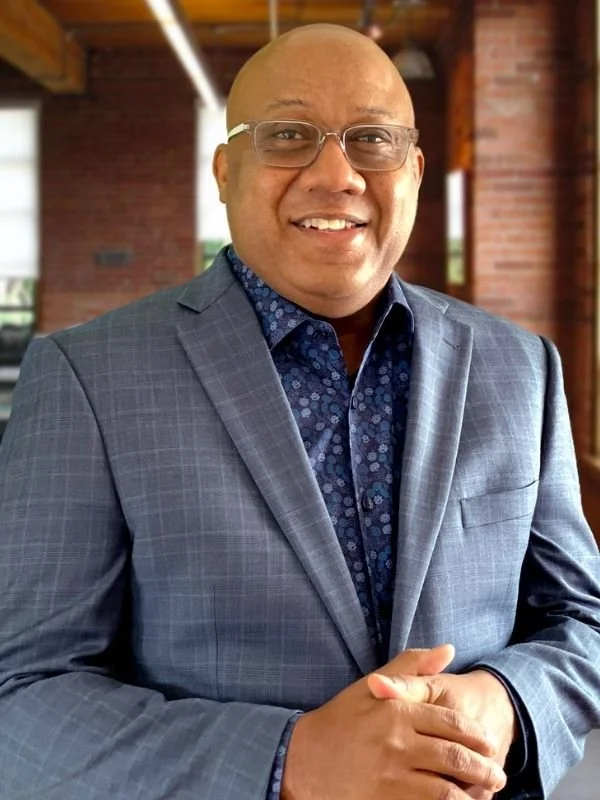
Benefactors Spotlight: Getting to Know Dr. George L. Askew
In celebration of Black Philanthropy Month and Give 8/28, we're excited to spotlight some of the inaugural members of Benefactors, a national Black giving collective co-led by the Young, Black & Giving Back Institute and the Greater Washington Community Foundation.
Years before he ever heard of Benefactors, Dr. George L. Askew decided to run a little experiment. While working as a deputy commissioner of health in New York, he started picking up loose change off the sidewalks during his daily walks. The ‘City that Never Sleeps’ was surprisingly lucrative. By the end of the year, he collected $28.37.
Rather than pocket the change, George decided to double the amount and ask his social media network for suggestions on which nonprofit he should donate the funds to.
The post went viral, garnering dozens of recommendations, including several he had never heard of. In the end, two donations of $30 were made to LitWorld and the Homeless Children’s Playtime Project. The exercise became an annual tradition – a small, seemingly insignificant act of charity that helped plant the seeds of greater things to come.
A Career Built on Public Service
Dr. Askew grew up in a working-class household in Cleveland, Ohio. He was one of the first children enrolled in Cleveland’s Head Start program – an early childhood education initiative George still champions to this day. He would go on to earn a bachelor’s degree in psychology and social relations from Harvard University and a Doctorate of Medicine from Case Western Reserve University.
A pediatrician at heart and in practice, in 2000, George moved to the DC area for a fellowship focused on child advocacy work – a stint he expected to last just ten months. He and his wife never really left.
Over the next fifteen years, George founded Docs for Tots, a nonprofit bringing together pediatricians to advocate for early child health, helped lead Voices for America’s Children, and served as a first Chief Medical Officer with the US Department of Health and Human Services’ Administration for Children and Families under the Obama Administration – before accepting an exciting role as the Deputy Commissioner of Health with the New York City Department of Health and Mental Hygiene.
A short time later, a different kind of pull brought him back to the DC region. Senator Angela Alsobrooks, then running for Prince George's County Executive, invited him to join her cabinet as the Deputy Chief Administrator for Health, Human Services, and Education in Prince George’s County. George and his wife, Dr. Katherine F. Russell, a dean at the University of Maryland, had just bought a home in Riverdale Park — so the timing lined up.
“Living in Prince George’s County quickly felt like home to me,” George recalls. “I had not lived in a predominantly Black and Brown community since my childhood in Cleveland and my year living in Ghana. It gave me an extra sense of community and desire to give back.”
Soon after, George and his wife established an endowed scholarship fund at the University of Maryland, the Dr. Katherine F. Russell and George L. Askew, MD Student Experience Endowment, to support undergraduate students from Prince George’s County pursuing summer internship experiences.
Benefactors – A Foray into Collective Giving
In 2024, George attended the annual conference for the Association of Black Foundation Executives (ABFE), where he was introduced to Benefactors - a new giving circle launched in partnership with the Young, Black, & Giving Back Institute and the Greater Washington Community Foundation.
The initiative was created to empower individuals who want to invest in Black communities in meaningful ways. Together, members pool resources, learn about impactful nonprofit organizations, and participate in a collaborative grantmaking process. To date, the initiative has invested more than $80,000 to support 9 different organizations across the country.
At the time, George was serving as the President & CEO of the Meyer Foundation, one of the largest philanthropic funders in the region. Nevertheless, he was impressed by the room full of young Black professionals who were interested in getting involved in philanthropy.
“I looked around the room and thought, 'I wish I had this thought when I was that age.' I'm not really young anymore, but I wanted to be a part of this — and to support these young people.”
George’s perspective was invaluable – especially as the collective began to establish their grantmaking process. As someone who has been on both sides of that process (as a nonprofit leader and as a grantmaker), George was able to share insights with other aspiring philanthropists about ways to make a greater impact.
For George, the value of a giving circle isn't measured only in dollars. It's in what it teaches participants about their own capacity to make a difference.
“It gives Black and Brown folks a better understanding of what our potential is as philanthropists,” he said. “It makes it tangible what even small giving back can do for organizations in our communities that are sometimes struggling to survive but doing great work. Our own individual contributions may be small, but our larger contribution to our community of color can be grand if we work together.”
He points to models like Give 8/28 and Benefactors as evidence of something bigger philanthropy could learn from: pooled decision-making that puts organizations, rather than institutions, at the center.
“Philanthropy has a history of deciding what it thinks is important,” George said. “We need to keep listening to what communities actually need. A giving circle has an advantage there — it's closer to the ground.”
That intimacy and close interaction with hard-working organizations is one of the things that George says is most impactful about the Benefactors experience.
“There’s a personal pleasure in seeing someone who’s been working in the trenches, in their community finally being recognized when they least expect it,” George shared.
“For these folks who are toiling in anonymity, there may be just a small circle within their community who are aware of the work that they’re doing. But when a group of people from the DC area gets on a zoom call and tells them, ‘We think you’re doing great work! You don’t know that we’ve been watching you, but we have been and we think you deserve some extra support.’; it’s a fun feeling. It makes you want to give more and do more.”
Want to get involved? Benefactors is now accepting new members! To learn more, contact Neema Rwebangira at [email protected]
If you are a nonprofit organization, visit www.give828.org to learn about Give 8/28 – a national day of giving focused on uplifting organizations like yours!
The Community Foundation is proud to partner with the Young, Black, & Giving Back Institute to support nonprofits organizations through Give 8/28 and the Benefactors Giving Collective.