Found Through Translation: How Ayuda’s BUILD Cohort Provided Language Justice for DMV Communities

For years, Manuel Escalante didn't realize that the thing he was already doing — helping a friend understand a form, standing in for someone at a doctor's appointment, making sense of an official letter — was something people made a career out of.
“I knew interpreters existed,” he says, “I just didn't know that I could do that sort of thing full-time and get paid for it.”
Opening Career Pathways Through Language Access
Manuel came to the United States from Venezuela in 2015 for a college internship with GALA Hispanic Theatre. The experience not only helped launch his career in the nonprofit sector – it also helped him learn and practice English, which he later perfected through YouTube videos and street conversations. Since 2018, he's worked as an advocate for immigrants, refugees, and survivors of domestic violence and sexual assault – most recently with the Network for Victim Recovery of DC (now known as Volare).
For Manuel – and many immigrants - serving as a interpreter isn’t part of a job description; it’s part of their way of life – helping family members, friends, or neighbors with anything from doctors’ visits to a trip to the DMV.
“Interpreting is so much more than just transmitting information,” shared Tatiana Santos, Training and Technical Assistance Specialist at Ayuda, a nonprofit providing legal and social services access for immigrants. “Interpreters are facilitators -- they help people navigate systems that aren’t always designed to meet their needs.”
Language access is a growing field – particularly in the DC area – as institutions such as hospitals, legal clinics, and other service providers seek for ways to better connect with and serve diverse populations.
Ayuda has provided legal and social services (including interpretation) for immigrants in the DC area for over fifty years. During that time, they’ve observed that while the demand for full-time interpreters in the DC area is one of the highest in the nation, those interpreters don’t usually come from the communities they serve.
“The interpretation field comes with a lot of barriers to entry,” Paige Jordan, Senior Language Access Manager at Ayuda explained. “It’s not enough to just speak the language – there are trainings you need to take, certifications you need to earn, conferences you need to attend – in short, you need information and resources that a lot of these communities don’t have access to.”
In response to this, in 2025 Ayuda launched the BUILD Cohort, an innovative project funded by The Community Foundation’s Health Equity Fund that provided scholarships, resources, and community support to interpreters from underrepresented communities.
“It’s important for us to elevate people in the communities we’re serving,” Paige explained. “We want to validate and acknowledge the lived experience that they have and help them turn that into economic opportunity.”

Manuel Escalante, Interpreter and member of the BUILD Cohort
One Role, Many Different Paths
Within a few weeks, Ayuda received over 50 applications for the BUILD Cohort. In the end, 30 interpreters joined the inaugural cohort – including ten who came into the cohort with no formal training in interpretation except decades of experience in languages such as Spanish, Quechua, Haitian Creole, Urdu, Darii, Amharic, Vietnamese Sign Language and American Sign Language (ASL).
The inaugural cohort also included four Deaf interpreters, like Amelia Palmer. Born in Canada to Jamaican hearing parents, Amelia found her identity as a Black, Deaf woman when she came to study at Gallaudet University and learned about the growing field of Deaf Interpreting – which pairs members of the Deaf community with hearing ASL interpreters to ensure accuracy and cultural connectivity in the translation process.
“A lot of ASL Interpreter programs are designed for Hearing interpreters,” Amelia explained. “BUILD cohort helped connect me with the networks and resources I needed to become a Deaf interpreter.”
As part of the program, Ayuda’s Language Access team worked one-on-one to help cohort members develop a personalized plan based on their individual needs and interests.
For Amelia, that meant attending 5th Deaf Interpreter Conference (DIC5) – a 5-day National Conference for Deaf Intpreters in Northridge, California and The Black Interpreter Experience – a 2-day conference in North Carolina dedicated to empowering and elevating Black interpreters. At both events, Amelia met hundreds of peers from across her industry. She is now in the process of becoming a Certified Deaf Interpreter (CDI) and establishing her own business to provide equitable communication for Deaf clients and consumers – especially Deaf immigrants for whom ASL or English may not be their first language.
“I want to enable and facilitate communication that goes beyond language access – bridging both linguistic and cultural gaps,” Amelia shared.
Manuel on the other hand, chose to attend the National Judiciary Interpreters and Translators Conference in Atlanta, where he learned best practices for legal interpretation – a field where he hopes to establish himself as a successful full-time interpreter. He also was able to purchase a laptop, headset and other equipment to help him as he continues to grow his own business.
“Building a business is challenging – especially these days – but for me, this is the most immigrant thing I could do – take the skills and resources I have and build a way forward when the traditional path is not working. It wouldn’t have been possible without the BUILD cohort.”
Another cohort participant – Bethashley Cajuste – leveraged the BUILD Cohort to take medical interpretation classes in Haitian Creole. While they currently work at Volare, providing support for survivors of domestic violence in DC, Bethashley hopes to use their translation skills to advance restorative justice for the survivors they serve.
“BUILD allowed me to a take a ‘Breaking Silence’ interpreter training focused on providing trauma informed interpretation that is mindful of the experiences people bring to the space,” Bethashley shared.
As part of their training, Bethashley was able to connect with experienced interpreters in the space that helped build their confidence in their formal interpretation skills so that they could create safe spaces that empower the communities they serve and love.
“What I learned is this is going to be never-ending process – the learning never stops; whether it be new vocabulary or learning how to incorporate new tools -- there’s always more to learn in the interpretation field – and having a solid network that you can learn with and from makes all the difference.”
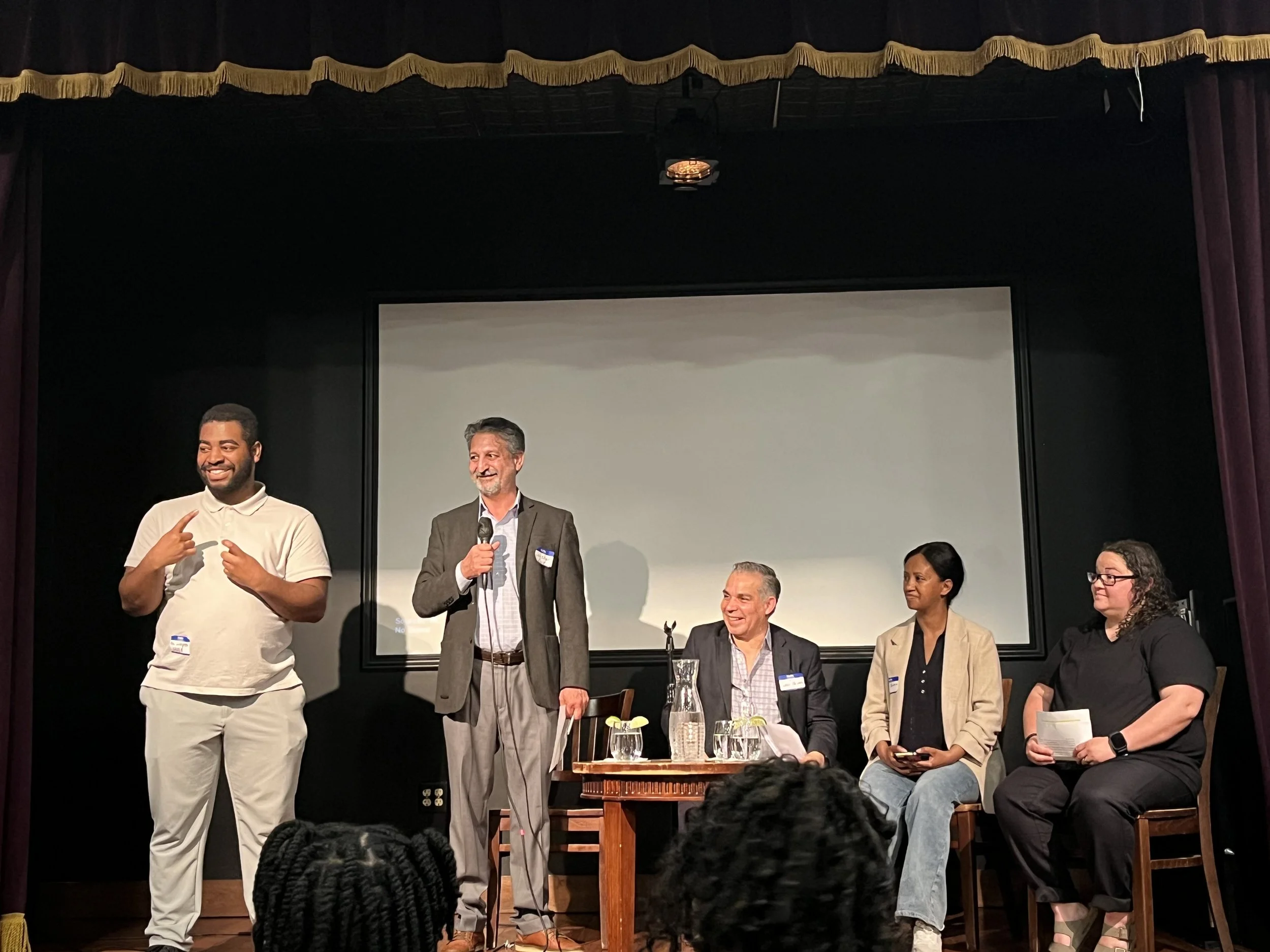
A panel of interpreters at a networking event for BUILD Cohort members.
Making the Case for Language Justice
As the inaugural BUILD cohort is coming to a close, Paige and Tatiana say the push for language justice and continued investment in access to translation services is perhaps more important now than ever, as language access and other services for marginalized communities have come under increased scrutiny in recent months.
“We need to step away from the idea that there is one language that is superior to all others,” Tatiana shared. “Language Justice is about ensuring that everyone has the power to speak in whatever language they feel most comfortable in and still have access to the basic services they need – whether that be legal, medical, or socio-economic.”
“The BUILD cohort is about empowering community members so they can help transform these systems to provide better access and better services to the communities that need it the most.”
“In a perfect world, we won't have a middleman,” Tatiana says — every system, from courts to hospitals to schools, would already have language access built in rather than bolted on. Until that's true, BUILD's bet is that the best people to close the gap are the ones who've stood on the other side of it: people who needed an interpreter once, and are now becoming one for someone else.
The Community Foundation is proud to partner with Ayuda’s BUILD Cohort through the Health Equity Fund. For more information about Ayuda’s Language Access Services, visit www.ayuda.com.